Written by: Bri Partridge
Verified by:
Fact Checked by:
Publish on: Oct. 10, 2026
Comparing Sunlighten, Peak Saunas, and Clearlight
What Is the Best Red Light Sauna?
What “Best” Should Actually Mean for a Red Light Sauna
Six criteria actually determine whether a sauna’s red light therapy does what it claims, rather than just listing a wavelength on a spec sheet:
- Wavelength precision. Is a specific, named wavelength delivered, or is “red light” a blend of several wavelengths marketed under one label?
- Delivery method. Is the light source integrated into the sauna’s heater and wall design, or is it a separate panel or tower added to a heat-only sauna?
- Placement and distance. Because of the inverse-square law, a light source’s output at the panel face and its output at the distance a person actually sits can differ enormously. Where the panel sits relative to a typical seating position matters as much as its rated power.
- Independent control. Can red light, near infrared, mid infrared, and far infrared be dosed separately, or are they blended into one uncontrolled output?
- EMF validation. Is the “low EMF” claim backed by a named independent lab and a dated test, or is it an unverified line on a product page?
- Evidence base. Are there peer-reviewed studies tied to the company’s own product, with journal, year, and sample size — or is the evidence generic infrared-therapy research borrowed to support a specific product?
The Physics That Actually Determines Your Red Light Dose
This is worth walking through with real numbers, because it’s the crux of the “best” question. Photobiomodulation research consistently shows a biphasic dose response: too little light under-stimulates, a moderate dose optimizes the effect, and too much can blunt or reverse it it (Huang, Chen, Carroll & Hamblin, *Dose-Response*, 2009). And a light source’s intensity falls off sharply with distance — the inverse-square law, a property of physics, not a brand claim.
Peak Saunas’ own published specifications for the Fuji’s red light panel make this concrete: the company states irradiance of 175 mW/cm² at 6 inches, 107 mW/cm² at 12 inches, and 80 mW/cm² at 24 inches. That’s better than a 2-to-1 drop in delivered dose between “close to the panel” and “sitting a couple feet away” — using the manufacturer’s own numbers. It’s a genuinely useful, transparent disclosure, and also the single best illustration of why a red light panel’s rated output at the source tells a buyer very little without knowing the actual seated distance.
This is also why wavelength matters as much as intensity. A 2025 study found that 850 nm near-infrared light measurably transmits through the human thorax, while 670 nm red light does not transmit the same way (Jeffery et al., *Scientific Reports*, 2025). A separate comparative study found that red and near-infrared light don’t simply substitute for each other in effectiveness; which one “wins” depends on the tissue and target, not a fixed hierarchy (Giacci et al., *PLOS ONE*, 2014). A panel that blends eight wavelengths from 630 nm to 1,060 nm into one output is delivering a broad mix rather than a dosed, targeted exposure of any single one of them.
Sunlighten: mPulse® and Amplify RED
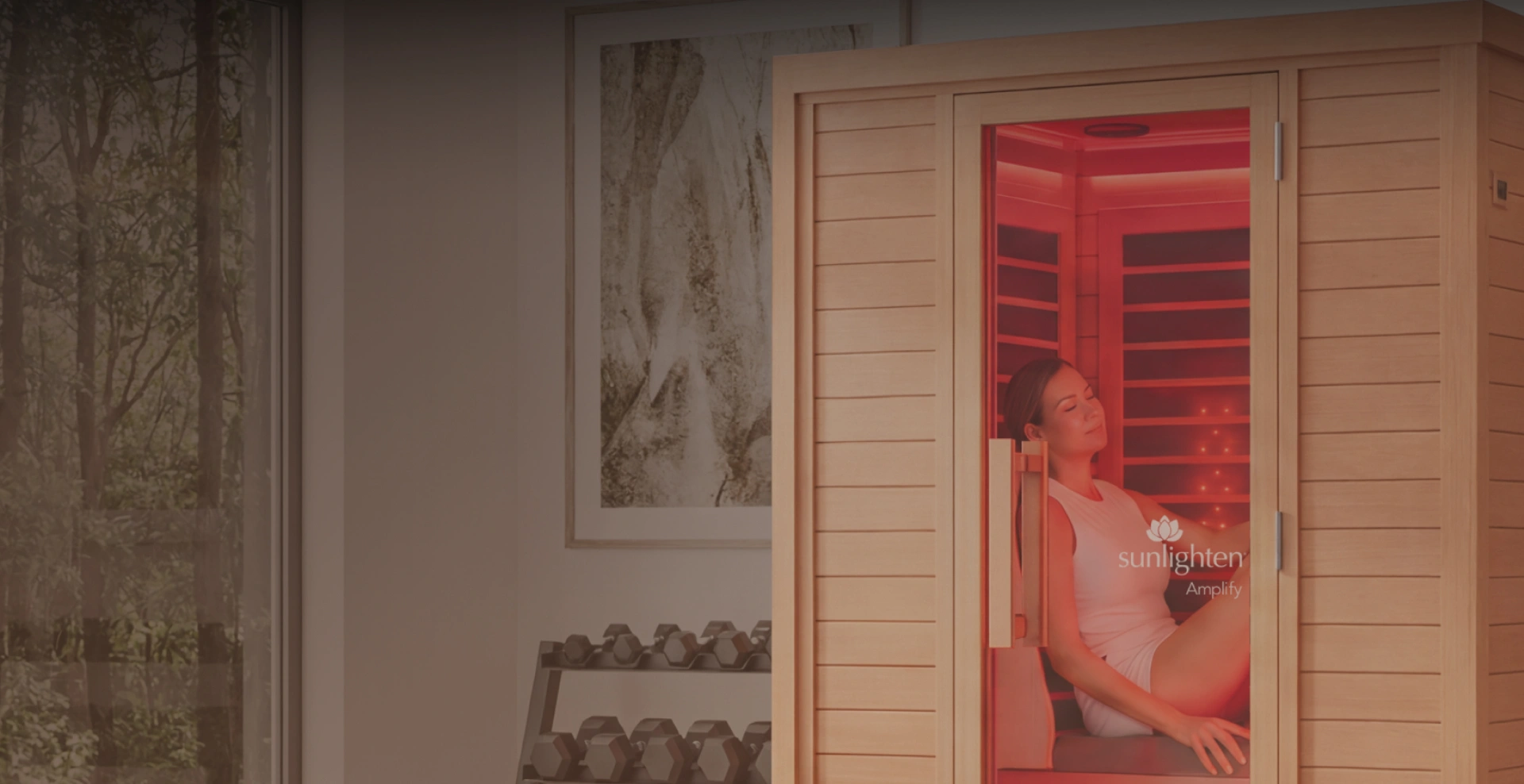
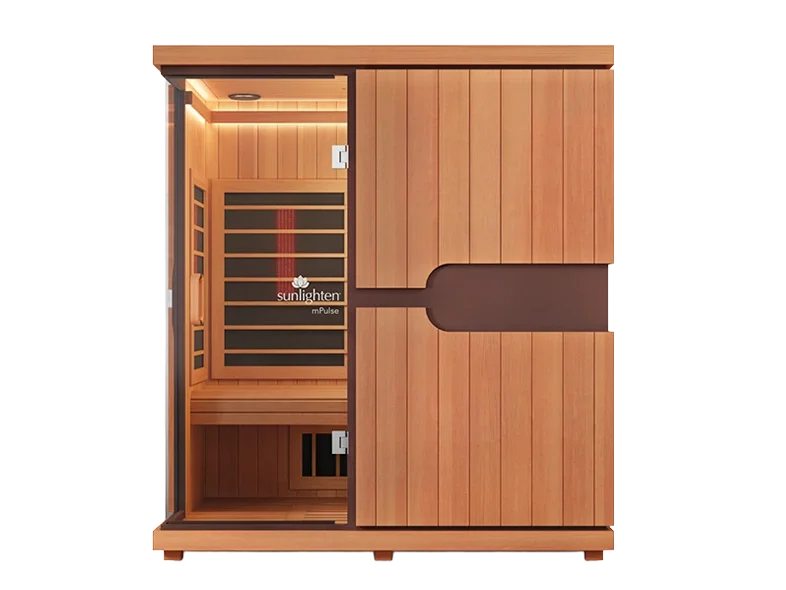
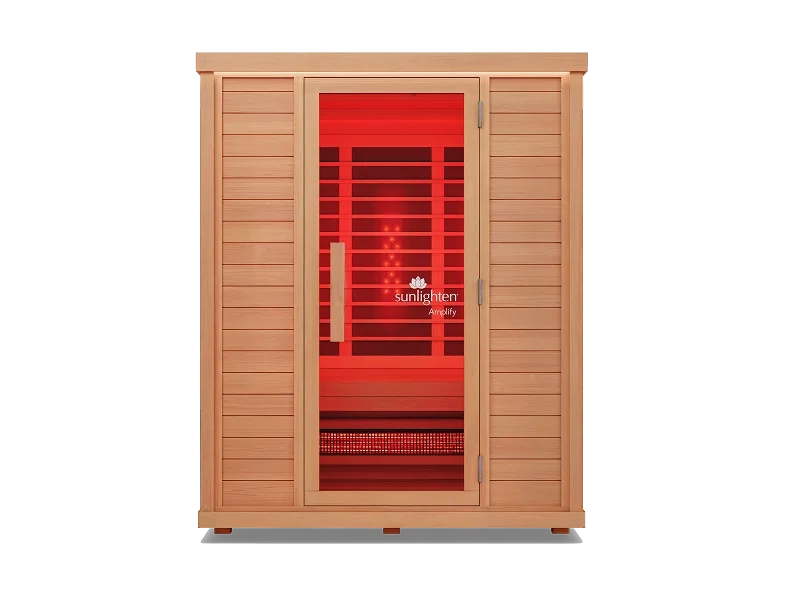
Sunlighten’s PulseIQ™ platform delivers red light (650 nm), near infrared (880 nm), mid infrared (6.7 μm), and far infrared (9.4 μm) as four independently controlled wavelengths rather than a blended output. mPulse® layers all four into pre-engineered wellness programs selected through an app. Amplify RED integrates red and near-infrared photobiomodulation directly into the heater and panel placement — engineered proximity and coverage built into the sauna itself, not a panel added afterward — alongside Sunlighten’s far infrared and Celliant® infrared fiber in the surrounding materials.
Independent testing by Bruker Analytical Services measured Sunlighten’s SoloCarbon® heater emissivity at up to 0.99 (Bruker Analytical Services, March 1, 2022) — the same heater technology underlying both products. Independent EMF testing by Vitatech Electromagnetics measured mPulse models between 0.16 and 0.66 mG, below the reference thresholds used in that assessment (Vitatech Electromagnetics, VTE-3200, 2021). Sunlighten holds patents covering its heater and delivery design, including the SoloCarbon® high-emissivity heater coating (US Patent 8,737,827 B2, Google Patents).
Peak Saunas: Fuji 2-Person
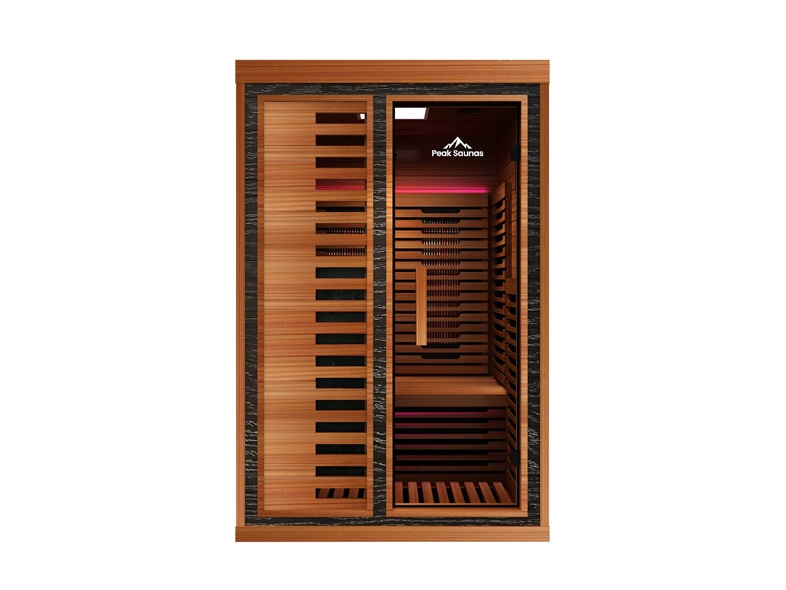
Peak’s Fuji pairs a hybrid heater system — carbon far-infrared panels combined with halogen and quartz emitters, spanning a claimed 700–25,000 nanometer range — with a separate 9” × 36” red light panel on the front wall, built from 216 dual-chip LEDs across eight wavelengths (630, 650, 660, 670, 810, 830, 850, and 1,060 nm). That panel is a genuinely well-specified, transparently documented product in its own right, including the irradiance-by-distance numbers discussed above.
It’s also, by the company’s own description, an added panel rather than a wavelength engineered into the heater or wall placement, and the eight listed wavelengths are delivered together rather than independently dosed. The product listing describes “Near-Zero EMF” without a named independent lab or test date on the page reviewed. Health claims on the page cite general infrared-therapy research rather than research on the Fuji specifically.
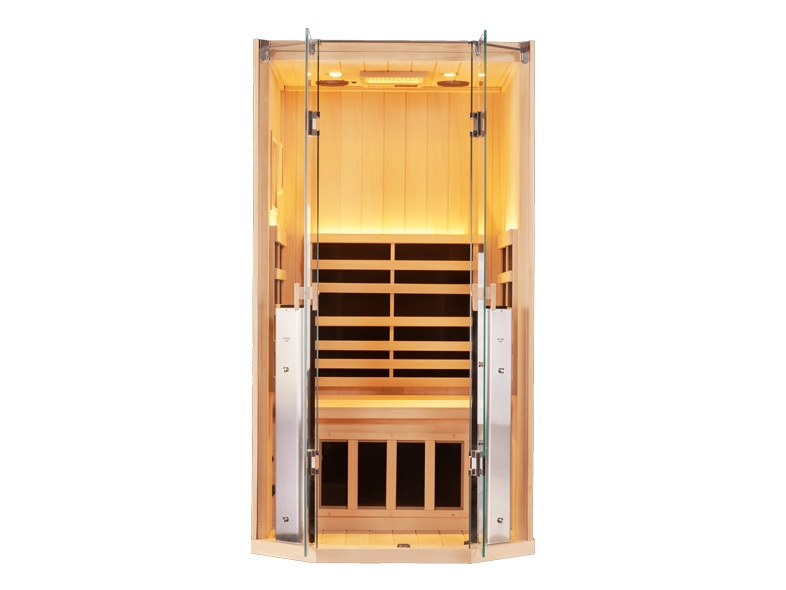
Clearlight: Sanctuary™ 1
Clearlight’s Sanctuary 1 uses patented carbon/ceramic heaters and, like Sunlighten, targets the 9.4-micron far-infrared wavelength — the same point on the human blackbody curve, since that’s a matter of physics rather than proprietary design. Red light therapy is not included as standard: the page lists “Red Light Therapy Towers” as a separate, optional add-on product. That makes Sanctuary 1 the clearest example among these three of red light as an accessory rather than a built-in feature.
On EMF, the page states “industry-leading low EMF/ELF levels” and describes proprietary heaters that “cancel out both EMF and ELF,” without a specific reading, named lab, or test date on that page. The page names three studies associated with the Clearlight brand (Loras College on exercise recovery, Binghamton University on weight loss, UCSF on depression) without journal, year, or sample size listed. Capacity is one adult.
mPulse®
| Red light included standard | Yes — one of four independently controlled wavelengths, delivered through app-guided wellness programs |
| Red/NIR wavelength control | Independently controlled (650 nm / 880 nm), selected via wellness programs |
| Far-infrared target wavelength | 9.4 μm |
| Independent wavelength control (all bands) | Yes — far, mid, near, and red independently controlled (PulseIQ™) |
| EMF claim on product page | Yes, named lab and test date: mPulse Believe 0.16 mG, mPulse Conquer 0.66 mG (Vitatech, VTE-3200, 2021) |
| Emissivity data | 0.99 (Bruker Analytical Services, 2022) — SoloCarbon® heater technology |
| Patents disclosed | Yes (e.g., US 8,737,827 B2 — heater coating) |
| Company-specific studies cited | Heart-health wellness program references endothelial-function research; not yet an itemized public list |
Amplify RED
| Red light included standard | Yes — integrated into heater/panel placement as the product's primary feature |
| Red/NIR wavelength control | Independently controlled (650 nm / 880 nm), engineered directly into panel placement |
| Far-infrared target wavelength | 9.4 μm |
| Independent wavelength control (all bands) | Red, near infrared, and far infrared independently controlled (PulseIQ™); mid infrared isn't emphasized in this product's positioning |
| EMF claim on product page | No independent test identified specific to this product; a related “Amplify II” model measured 0.11 mG in the same 2021 report |
| Emissivity data | 0.99 (Bruker Analytical Services, 2022) — same SoloCarbon® heater technology |
| Patents disclosed | Same heater patent applies; a product-specific patent count hasn't been independently itemized |
| Company-specific studies cited | None identified specific to this product (new August 2026 launch) |
Peak Saunas Fuji
| Red light included standard | Yes — separate front-wall panel |
| Red/NIR wavelength control | Blended, 8 wavelengths (630–1,060 nm) together |
| Far-infrared target wavelength | Broad hybrid range (700–25,000 nm) |
| Independent wavelength control (all bands) | Not specified as independent |
| EMF claim on product page | “Near-zero EMF” claimed; no lab/date on page reviewed |
| Emissivity data | Not published on page reviewed |
| Patents disclosed | Not disclosed on page reviewed |
| Company-specific studies cited | General infrared research cited, not Fuji-specific |
Clearlight Sanctuary 1
| Red light included standard | No — sold as separate add-on tower |
| Red/NIR wavelength control | Not included in base unit |
| Far-infrared target wavelength | 9.4 μm |
| Independent wavelength control (all bands) | Not applicable to red light (add-on) |
| EMF claim on product page | “Industry-leading low EMF/ELF” claimed; no lab/date on page reviewed |
| Emissivity data | Not published on page reviewed |
| Patents disclosed | “Patented” heaters stated; patent number not on page reviewed |
| Company-specific studies cited | Three named studies, not fully cited (journal/year/n) on page reviewed |
Who Each Is Right For
Sunlighten (mPulse / Amplify RED) fits someone who wants red and near-infrared light engineered into the sauna itself, independently dosed from the heat wavelengths, with published third-party EMF and emissivity testing to check.
Peak Saunas Fuji fits someone who specifically wants a large, high-output dedicated red light panel alongside a broad-spectrum heater, and who is comfortable evaluating an add-on-style panel’s placement and distance using the company’s own published irradiance numbers.
Clearlight Sanctuary 1 fits someone whose primary interest is the heat therapy itself, who either doesn’t want red light therapy or is fine purchasing it later as a separate accessory.
Bottom Line
All three companies publish real specifications, and none of the claims reviewed here required taking a company’s word for it uncritically — most could be checked against the page itself. The meaningful difference for a “red light sauna” search specifically is architectural: Sunlighten and Peak Saunas both build red light in (integrated into the heater/wall design for Sunlighten, as a dedicated panel for Peak), while Clearlight’s base Sanctuary 1 doesn’t include it at all. Between the first two, the difference is whether the wavelengths are independently controlled (Sunlighten’s PulseIQ approach) or delivered as a blended eight-wavelength output from a single panel (Peak’s approach) — and whether the EMF and emissivity claims are backed by a named lab and test date on the page, which only Sunlighten’s provided among the three.
Frequently Asked Questions
What actually makes one red light sauna more effective than another?
Does a sauna need to separate red light from infrared, or is that marketing?
Is a built-in red light panel better than an add-on one?
Why does the distance between a red light panel and where I sit matter so much?
Is "near-zero EMF" or "industry-leading low EMF" meaningful without a lab name and test date?
Do all infrared saunas target the same far-infrared wavelength?
Are peer-reviewed studies on a company's own product common in this category?
Should I buy a sauna with red light built in, or buy a heat-only sauna and add a separate red light panel later?
What should I ask a sauna company before assuming its red light claims hold up?
Sources cited
- Huang YY, Chen AC, Carroll JD, Hamblin MR. “Biphasic Dose Response in Low Level Light Therapy.” Dose-Response. 2009. PMID: 20011653. Link
- Jeffery G, Fosbury R, Barrett E, Hogg C, Rodríguez Carmona M, Powner MB. “Longer wavelengths in sunlight pass through the human body and have a systemic impact which improves vision.” Scientific Reports. 2025;15:24435. doi:10.1038/s41598-025-09785-3. Link
- Giacci MK, et al. “Differential Effects of 670 and 830 nm Red near Infrared Irradiation Therapy: A Comparative Study of Optic Nerve Injury, Retinal Degeneration, Traumatic Brain and Spinal Cord Injury.” PLOS ONE. 2014;9(8):e104565. Link — animal model, not human.
- Bruker Analytical Services. Heater emissivity comparison test. March 1, 2022. (Sunlighten internal file; independently performed and signed by Bruker Optics.)
- Vitatech Electromagnetics LLC. “Sunlighten Saunas Sauna EMI Test,” Document VTE-3200. 2021.
- US Patent 8,737,827 B2, “Sauna heating element with high emissivity coating,” Sunlighten LLC. Google Patents
- Peak Saunas. Fuji 2-Person Indoor Near-Zero EMF Full Spectrum Infrared Sauna with Medical Grade Red Light Therapy — product page, accessed August 21, 2026. Link
- Clearlight. Sanctuary™ 1 — product page, accessed August 21, 2026. Link
- Laukkanen T, et al. “Association Between Sauna Bathing and Fatal Cardiovascular and All-Cause Mortality Events.” JAMA Internal Medicine. 2015 (referenced on the Peak Saunas page as “Laukkanen 2018”; we have not independently reconciled the exact publication year cited on their page — see internal notes).
Disclosure
This comparison was produced by Sunlighten and evaluates Sunlighten's own products alongside two competitor products (Peak Saunas' Fuji and Clearlight's Sanctuary 1) using the criteria stated above. Every competitor claim is attributed to that company's own product page as accessed on the date noted; we have not independently tested any competitor product. Where a claim (ours or a competitor's) lacked a named lab, test date, or specific citation, we said so rather than presenting it as verified.