Written by: Bri Partridge
Verified by:
Fact Checked by:
Publish on: Oct. 10, 2026
Why People Mix the Two Up
The confusion is mostly visual. You can see red light — it’s the visible end of the spectrum, roughly 620–750 nm. You can’t see infrared, which starts around 700 nm and runs out to about 1 millimeter, covering near-infrared (NIR), mid-infrared (MIR), and far-infrared (FIR) bands. Because both are marketed under a “light therapy” or “infrared” umbrella, and because some panels and saunas combine them, it’s easy to assume they’re one thing with one effect. They aren’t. They’re different parts of the electromagnetic spectrum, absorbed by different structures in the body, on different timelines, for different outcomes (Sunlighten, “Is Red Light Therapy the Same as Infrared?”).
The Measurable Difference
VISIBLE
RED LIGHT
| Standard range | ~620–750 nm |
| What it does | Absorbed largely at the skin surface; supports collagen, skin repair, mood |
| Sunlighten wavelength | 650 nm |
NEAR INFRARED
(NIR)
| Standard range | ~700–1,400 nm |
| What it does | Penetrates more deeply than red light; drives most of the cellular/mitochondrial signaling |
| Sunlighten wavelength | 880 nm |
MID INFRARED
(MIR)
| Standard range | ~1.4–3 μm (CIE) |
| What it does | Absorbed by water in deeper tissue; supports muscle and joint-level recovery |
| Sunlighten wavelength | 6.7 μm |
FAR INFRARED
(FIR)
| Standard range | ~3–100 μm (CIE) |
| What it does | Absorbed as heat; raises core body temperature, drives sweating and circulation |
| Sunlighten wavelength | 9.4 μm |
A note on that last row: far infrared at 9.4 microns isn’t an arbitrary number. It sits at the peak of the human body’s own blackbody radiation curve (a function of Wien’s displacement law), which is why it’s the wavelength most efficiently absorbed by the body as heat (Vatansever & Hamblin, Photonics & Lasers in Medicine, 2012). Sunlighten’s SoloCarbon® heaters are engineered to match it — independent testing by Bruker Analytical Services measured the heater’s emissivity (how efficiently it emits usable infrared energy rather than reflecting it) at up to 0.99, versus 0.93 for a standard carbon-surround heater (Bruker Analytical Services test, March 1, 2022).
What Red Light Therapy Actually Does
Red light therapy is a light signal, not a heat treatment. At 620–670 nm, it’s absorbed mostly in the skin and upper tissue layers, where it appears to support mitochondrial activity in skin cells, which in turn supports collagen and elastin production. Two of the more frequently cited human trials: a controlled trial of 90 volunteers found that combined red and near-infrared LED treatment improved patient-rated skin appearance, fine lines, and measurable intradermal collagen density after a treatment course (Wunsch & Matuschka, Photomedicine and Laser Surgery, 2014 — note this trial used a non-Sunlighten LED device and was funded by the device manufacturer, which is worth disclosing rather than hiding). A separate trial combining 633 nm and 830 nm light in 31 subjects found measurable improvement in periorbital wrinkle scores and skin surface profilometry at 12 weeks (Russell, Kellett & Reilly, Journal of Cosmetic Laser Therapy, 2005).
Because red light works through a slower, secondary cellular pathway rather than direct heat, its effects tend to build over time rather than show up immediately in a single session — which is a real and useful distinction from how a sauna feels.
What the evidence does not clearly support: claims that red light alone “reduces cellulite” or “strengthens the immune system.” A comprehensive review of low-level laser therapy for fat-layer reduction found the evidence mixed and dependent on device, dose, and protocol — not a settled result (Avci & Hamblin, Lasers in Surgery and Medicine, 2013), and no controlled human trial directly ties red light exposure to immune-system strengthening. We’d rather say that plainly than repeat a claim that doesn’t hold up under a citation check.
What Infrared Saunas Actually Do
An infrared sauna is fundamentally a heat therapy that also happens to use light-based wavelengths to deliver that heat more efficiently than a traditional hot-air sauna. Far infrared (9.4 microns) is the workhorse: it’s absorbed by water in tissue, converts to heat, and is what raises core body temperature, dilates blood vessels, and drives the sweat response people associate with detoxification and cardiovascular benefit. In a two-week trial of 25 men with coronary risk factors, repeated far-infrared sauna sessions significantly improved flow-mediated vascular dilation — a measure of endothelial (blood vessel) function — compared with no improvement in the sham-equivalent measure (Imamura et al., Journal of the American College of Cardiology, 2001). Separately, a controlled study measuring toxic elements in blood, urine, and sweat found that induced sweating excreted certain toxic elements not otherwise detectable in serum, supporting sweating as a genuine (if partial) elimination pathway (Genuis et al., Archives of Environmental Contamination and Toxicology, 2011).
Mid infrared (6.7 microns) penetrates somewhat deeper and is more associated with muscle- and joint-level recovery, while near infrared (880 nm) — despite being infrared and not visible — behaves less like a heat source and more like red light’s deeper-reaching cousin: it drives a large share of the cellular energy (mitochondrial ATP) signaling that people associate with recovery and regeneration. A controlled cell-culture study found that combined red and near-infrared light exposure increased mitochondrial membrane potential and ATP synthesis, peaking three to six hours after exposure and still measurable at 24 hours (Ferraresi et al., Photochemistry and Photobiology, 2015) — one reason near-infrared and red light are often discussed as a slower-building, “day-after” effect rather than an immediate one.
On the specific, often-repeated claim that far infrared “raises core body temperature by three degrees”: Sunlighten has internal single-subject data showing roughly a 3°F rise in core temperature over a 30-minute session in a Solo sauna, measured minute-by-minute. That’s a real internal measurement, but it’s a single participant, not a peer-reviewed, published study — a materially different level of evidence than the Imamura or Genuis trials above, and we’re labeling it that way rather than presenting it with the same confidence.
Dose, Distance, and Why “More Powerful” Isn’t the Same as “More Effective”
Two physical principles govern how much of either red light or near-infrared actually reaches the body, regardless of how the source is marketed:
The inverse-square law. Light intensity falls off sharply as distance from the source increases — a basic property of how light radiates, not a Sunlighten-specific claim. In practice, this means a device’s power rating at the source tells you very little; what matters is how much energy is actually reaching the body at the distance a person sits or stands.
Biphasic dose response. Photobiomodulation research consistently shows that light-based cellular effects follow a biphasic curve: too little light under-stimulates, a moderate dose optimizes the response, and too much can flatten or even inhibit the effect entirely (Huang, Chen, Carroll & Hamblin, Dose-Response, 2009). This is part of why “the most powerful panel” is the wrong question — the right one is whether a device delivers a controlled, consistent dose at the distance people actually use it.
Together, these two principles are the practical reason Sunlighten separates and independently controls wavelength, placement, and dose in its saunas rather than relying on a single high-output panel and hoping the user sits close enough, long enough, consistently enough.
Choosing Between Them
- Choose infrared heat when the goal is core-body heating, sweating, circulation, or the cardiovascular and recovery benefits tied to heat stress.
- Choose red light when the goal is targeted, surface-level support for skin appearance, and — via near infrared specifically — deeper cellular energy and recovery signaling.
- Choose both together when you want the systemic benefit of infrared heat and the cellular-signal benefit of light in one session, which is the reasoning behind building both into a single sauna rather than treating red light as a bolt-on accessory.
The one claim worth retiring: that red light can substitute for far infrared, or vice versa. Red light doesn’t meaningfully raise core temperature, and far infrared doesn’t deliver the same surface-level skin signaling red light does. They’re different tools solving different problems.
How Sunlighten Builds Both Into One Sauna
Sunlighten’s premium saunas don’t treat red light as a panel bolted onto a heat box. Two products illustrate two different ways of solving the same underlying engineering problem — delivering red light, near infrared, mid infrared, and far infrared as separate, independently controlled wavelengths instead of one uncontrolled blend, through the PulseIQ™ platform.
mPulse® is Sunlighten’s intelligent sauna platform. It separates and independently controls all four wavelengths — red (650 nm), near infrared (880 nm), mid infrared (6.7 μm), and far infrared (9.4 μm) — and layers them into six pre-engineered wellness programs (including a heart-health program built around the same endothelial-function research referenced above) that a user selects through an app rather than guessing at settings. Its SoloCarbon® heaters are the ones independently tested at up to 99% emissivity, and Sunlighten’s saunas have been tested for AC electromagnetic emissions by Vitatech Electromagnetics, with the mPulse Believe model measuring 0.16 mG and the mPulse Conquer measuring 0.66 mG — both well below the reference thresholds used in that assessment (IEEE Std C95.6-2002 / EN 55035:2017) (Vitatech Electromagnetics, VTE-3200, 2021).
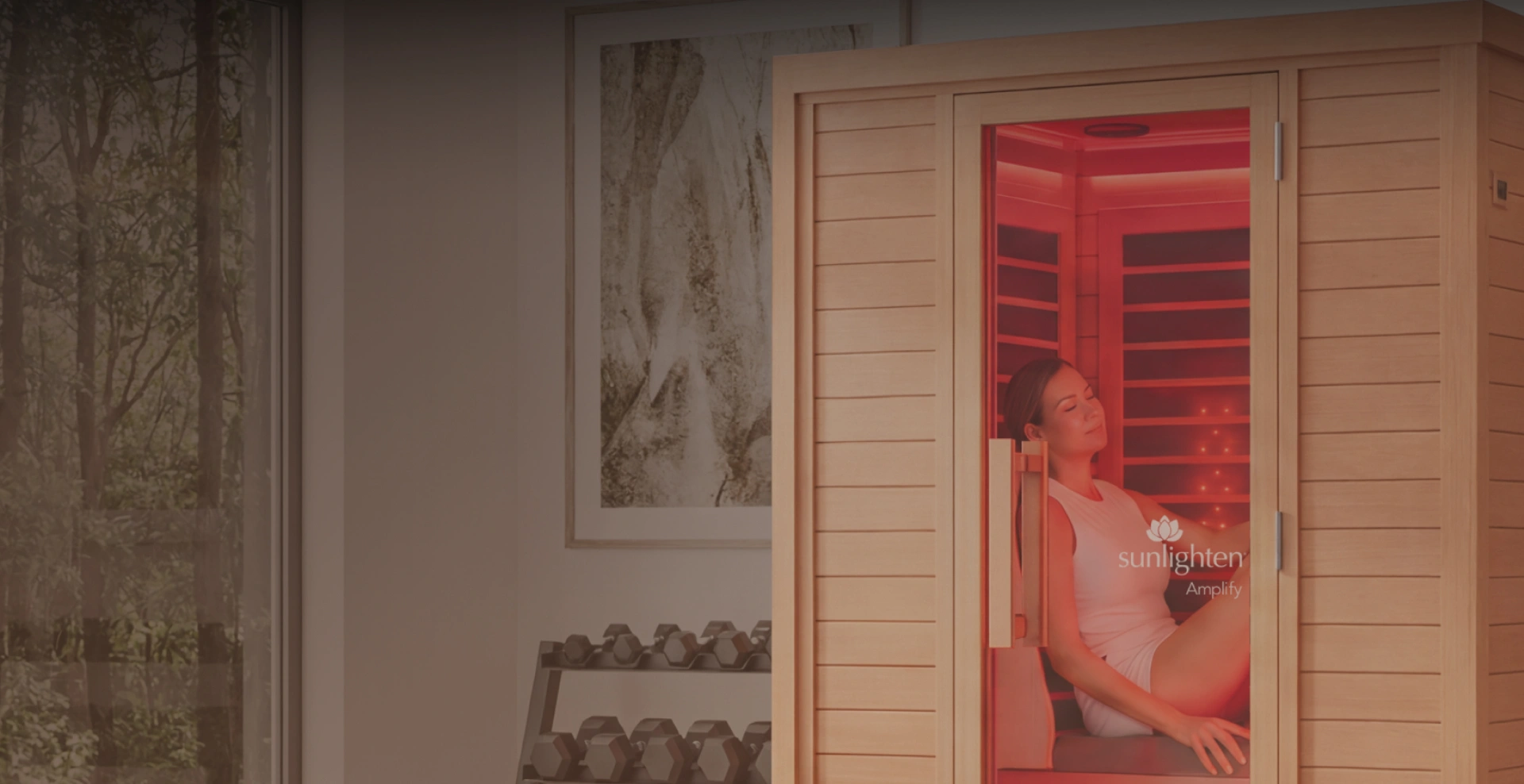
Amplify RED takes the same underlying science — integrated red and near-infrared photobiomodulation (PBM), Sunlighten’s 99%-emissive far infrared, and Celliant® infrared fiber built into the surrounding materials — and delivers it through simpler, more direct controls built for intensity and choice rather than guided programs. Where mPulse is built around personalization, Amplify RED is built around control and heat intensity: a full-spectrum infrared experience with red and near-infrared light engineered into the panel placement itself (not an accessory panel), so proximity and dose are addressed by design rather than left to how close a person happens to sit to a separate device. Sunlighten holds patents covering this heater and delivery approach, including the SoloCarbon® high-emissivity heater design (US Patent 8,737,827 B2 — viewable on Google Patents), among more than three dozen patents across the company’s sauna technology.
The two products answer the same underlying question — “how do I get a controlled dose of red light, near infrared, and heat instead of a single uncontrolled blend?” — differently: mPulse through guided personalization, Amplify RED through integrated intensity and simpler control. Neither is “better”; they’re built for different preferences on the same underlying science.
Learn more: What Is Infrared Light? · Red Light Therapy · mPulse Infrared Saunas · The Difference Between Red Chromotherapy and Red Light Therapy
Frequently asked questions
Does an infrared sauna emit red light?
Is near-infrared in a sauna the same as a red light therapy panel?
Which is better for skin health — red light therapy or an infrared sauna?
Which is better for muscle recovery — red light therapy or an infrared sauna?
Can red light therapy replace an infrared sauna, or vice versa?
How much red light exposure is needed to see a benefit, compared to an infrared sauna session?
Is there scientific research behind red light therapy claims, or is it mostly anecdotal?
Does distance from the light source actually matter that much?
What’s the difference between chromotherapy (colored light) and red light therapy?
Should I choose mPulse or Amplify RED?
Sources cited
- Huang YY, Chen AC, Carroll JD, Hamblin MR. “Biphasic Dose Response in Low Level Light Therapy.” Dose-Response. 2009. PMID: 20011653. Link
- Vatansever F, Hamblin MR. “Far infrared radiation (FIR): Its biological effects and medical applications.” Photonics & Lasers in Medicine. 2012. PMC3699878. Link
- Ferraresi C, et al. “Low-level Laser (Light) Therapy Increases Mitochondrial Membrane Potential and ATP Synthesis in C2C12 Myotubes with a Peak Response at 3–6h.” Photochemistry and Photobiology. 2015. PMID: 25443662. Link
- Wunsch A, Matuschka K. “A controlled trial to determine the efficacy of red and near-infrared light treatment in patient satisfaction, reduction of fine lines, wrinkles, skin roughness, and intradermal collagen density increase.” Photomedicine and Laser Surgery. 2014. PMID: 24286286. Link — industry-funded trial, non-Sunlighten device; disclosed above.
- Russell BA, Kellett N, Reilly LR. “A study to determine the efficacy of combination LED light therapy (633nm and 830nm) in facial skin rejuvenation.” Journal of Cosmetic Laser Therapy. 2005. PMID: 16414908. Link
- Whelan HT, et al. “Effect of NASA light-emitting diode irradiation on wound healing.” Journal of Clinical Laser Medicine & Surgery. 2001. PMID: 11776448. Link
- Barolet D, Boucher A. “Radiant near infrared light emitting diode exposure as skin preparation to enhance photodynamic therapy inflammatory type acne treatment outcome.” Lasers in Surgery and Medicine. 2010. PMID: 20166163. Link
- Avci P, Hamblin MR. “Low-level laser therapy for fat layer reduction: a comprehensive review.” Lasers in Surgery and Medicine. 2013. PMID: 23749426. Link
- Imamura M, et al. “Repeated thermal therapy improves impaired vascular endothelial function in patients with coronary risk factors.” Journal of the American College of Cardiology. 2001. PMID: 11583886. Link
- Genuis SJ, Birkholz D, Rodushkin I, Beesoon S. “Blood, urine, and sweat (BUS) study: monitoring and elimination of bioaccumulated toxic elements.” Archives of Environmental Contamination and Toxicology. 2011. PMID: 21057782. Link
- Bruker Analytical Services. Heater emissivity comparison test. March 1, 2022. (Sunlighten internal file; independently performed and signed by Bruker Optics.)
- Vitatech Electromagnetics LLC. “Sunlighten Saunas Sauna EMI Test,” Document VTE-3200. 2021.
- US Patent 8,737,827 B2, “Sauna heating element with high emissivity coating,” Sunlighten LLC. Google Patents