Written by: Bri Partridge
Verified by:
Fact Checked by:
Publish on: Oct. 10, 2026
4 Two-Person Cabins Compared
Best High-Heat Infrared Saunas of 2026
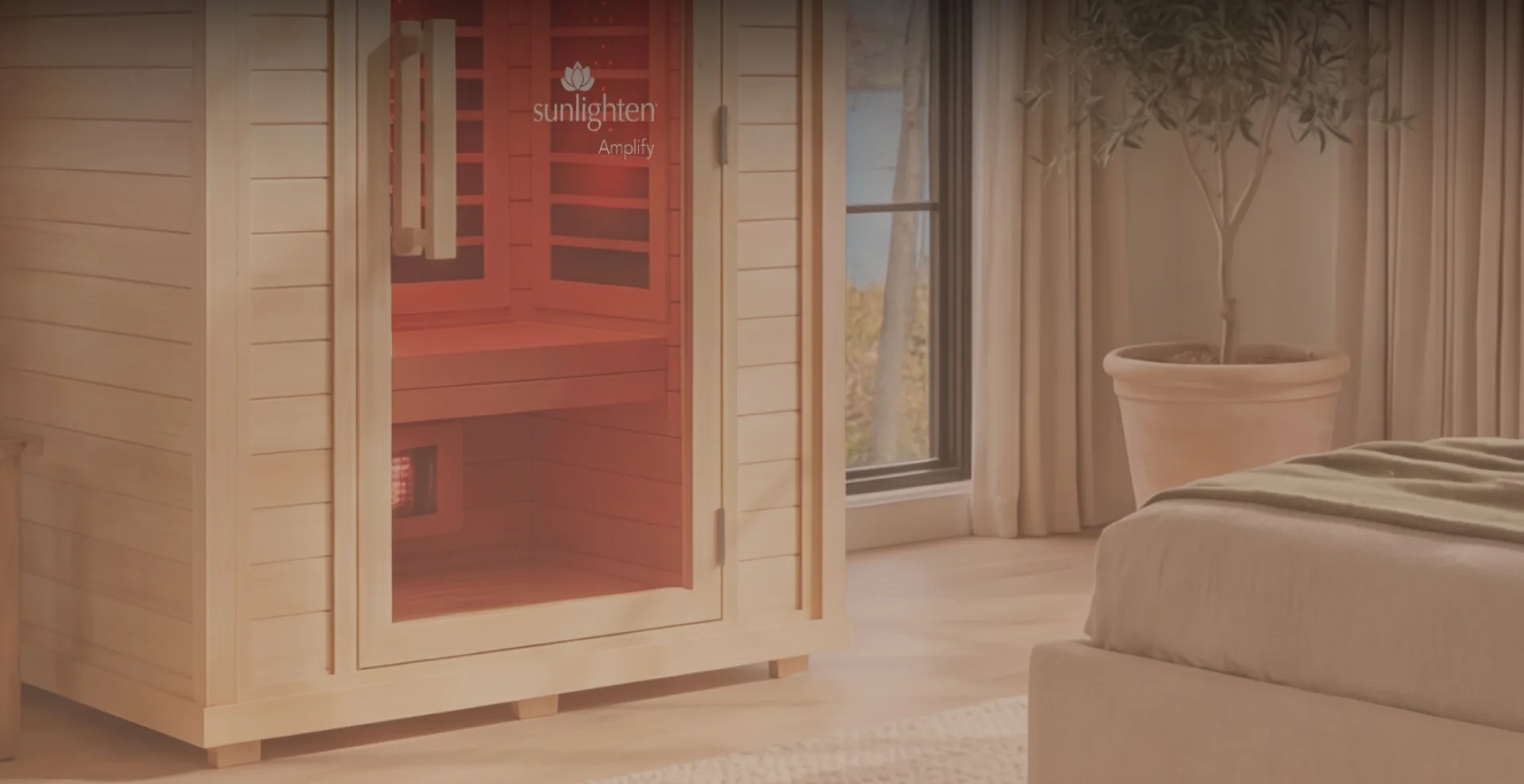
It publishes the highest maximum temperature in the group at 170°F, the only figure above 165°F. Its heaters carry the only independently measured emissivity here — 0.99, measured by Bruker Analytical Services with a named instrument, tester and test date — where the one other 99% claim in this comparison is self-declared by that company's own statement. It is the only cabin that publishes its complete third-party EMF report rather than a summary or nothing at all. Its red and near-infrared light is engineered throughout the cabin walls rather than delivered by a freestanding tower or sold as a separate add-on. And it is the only one of the four that discloses the country its saunas are built in.
Where it doesn't lead, stated plainly: it requires a dedicated 240V circuit where one cabin here runs on ordinary household outlets, it blends its full-spectrum output rather than dosing wavelengths individually, and it publishes neither red light irradiance figures nor cabin-air VOC results — both of which a competitor here does publish.
The other three each lead somewhere, and this guide says where. The Sun Home Eclipse publishes the most thoroughly documented materials and VOC testing of the four, and is the heaviest cabin here. Heavenly Heat is the only cabin that reaches 165°F on ordinary household outlets, with no dedicated circuit and no electrician. Clearlight's Sanctuary 2 is the deliberate outlier — it isn't built for high heat, and says so on its own site.
One caveat applies to all four. Infrared saunas are increasingly sold on maximum temperature, and that is the one figure in this category no manufacturer has had independently verified — ours included.
Our top recommendations
About this comparison
This comparison is published by Sunlighten, and one of the four saunas is ours. Every competitor figure below comes from that company's own published pages, accessed September 23, 2026. Where a company doesn't publish something, we say "not published" rather than estimating. Where a Sunlighten claim rests on independent testing, the laboratory, instrument and test date are named so you can ask for the report.
The four at a glance
2-person indoor cabins, figures as published September 23, 2026
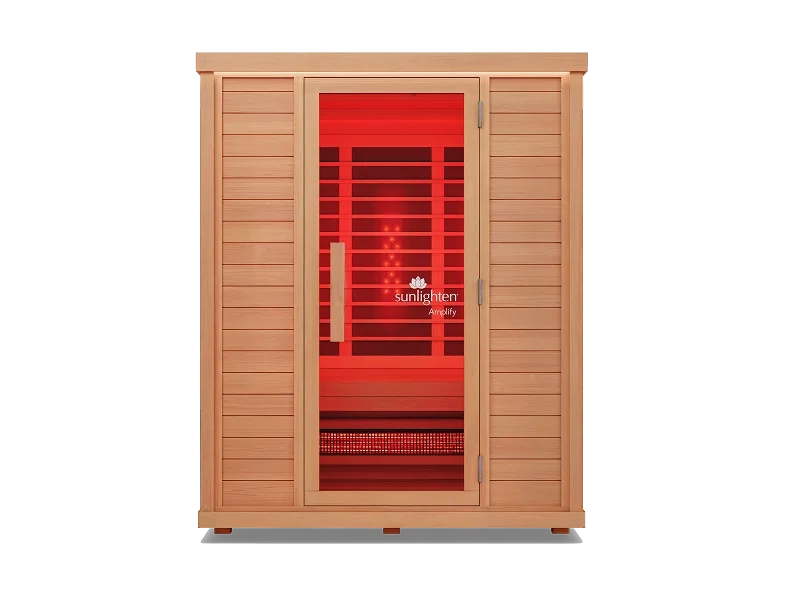
SUNLIGHTEN
AMPLIFY RED II
| Max temperature | 170°F ("under appropriate conditions") |
| Heaters | 5 far-infrared + 3 full-spectrum (3 × 500W); no floor heaters |
| Circuit required | Dedicated 240V 20A, NEMA 6-20 |
| Red light included | Yes — red + near-infrared integrated throughout the walls |
| Published irradiance | Not published |
| Heater emissivity | 0.99 — Bruker Analytical Services, 3/1/2022, named instrument and tester |
| EMF | Less than 1 mG, independently tested and third-party verified |
| Where it's manufactured | Disclosed — Sunlighten's own facility in Vietnam; electrical and EMF tested on every unit before shipping; warehoused in Kansas City |
| Weight | 529 lbs basswood / 562 lbs eucalyptus |
| Price | Quote-based |
| Warranty (residential) | 7 yr cabinetry & heaters · 3 yr controls · 1 yr glass/audio; customer pays freight |
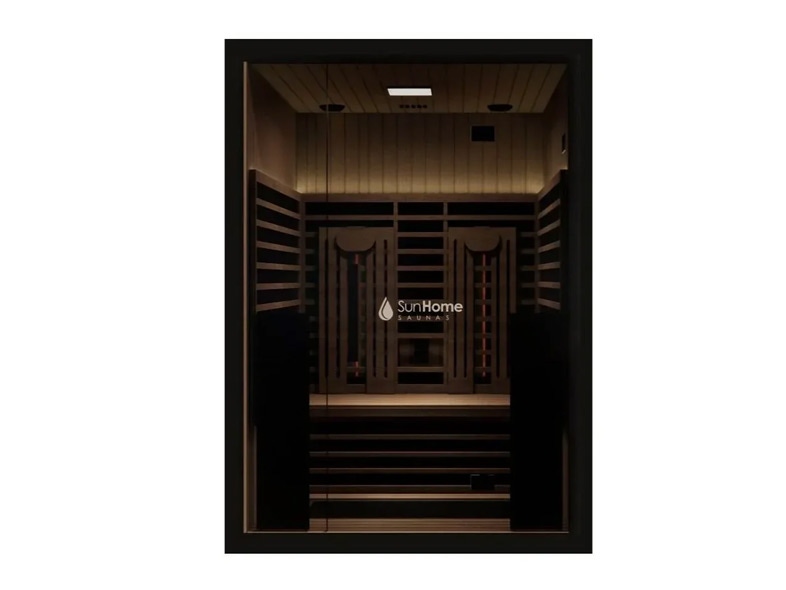
SUN HOME
ECLIPSE (2-PERSON)
| Max temperature | 165°F |
| Heaters | 6 far-infrared + 2 full-spectrum |
| Circuit required | Dedicated 30A circuit, NEMA L5-30 (120V / 2,820W / 23.5A) |
| Red light included | Yes — built-in towers, 660 + 850 nm, individual remote per tower |
| Published irradiance | Not published |
| Heater emissivity | 99% — Sun Home states it has not been third-party verified |
| EMF | 0.3–0.9 mG RMS at ~3 ft (Vitatech) per Sun Home's explainer; Eclipse page itself says only "patented shielding" |
| Where it's manufactured | Not disclosed — "Designed in California," HQ San Diego |
| Weight | 600 lbs |
| Price | $9,999 (reg. $10,599) — published |
| Warranty (residential) | "Limited lifetime," capped at 7 years by Sun Home's own terms; 90 days parts, labor and shipping free; non-transferable |
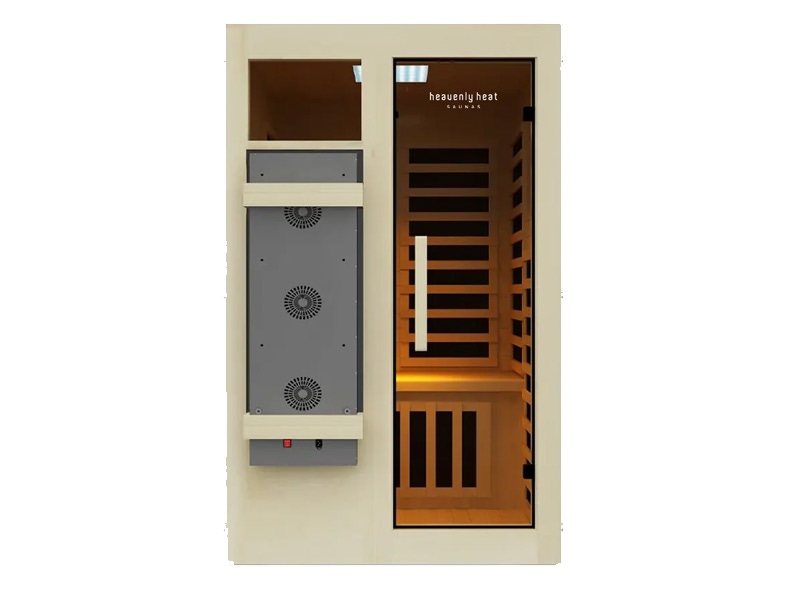
HEAVENLY HEAT
2-PERSON RED LIGHT
| Max temperature | 165°F — stated in the FAQ; the product page declines to give a figure |
| Heaters | Grounded carbon infrared; count not published |
| Circuit required | 120V — two 15A circuits or one dedicated 20A |
| Red light included | Yes — 630, 660, 810, 830, 850 nm panel |
| Published irradiance | 38.20 mW/cm² at 12″ · 36.39 at 24″ · 29.33 at 36″ |
| Heater emissivity | Not published |
| EMF | "Ultra-Low EMF/ELF <2mg"; methodology not published |
| Where it's manufactured | Not disclosed — "35+ years of American craftsmanship" |
| Weight | Not published |
| Price | $11,495 — published |
| Warranty (residential) | 10 yr cabinet, heaters and electrical · 5 yr red light panel; labor and shipping excluded; non-transferable |
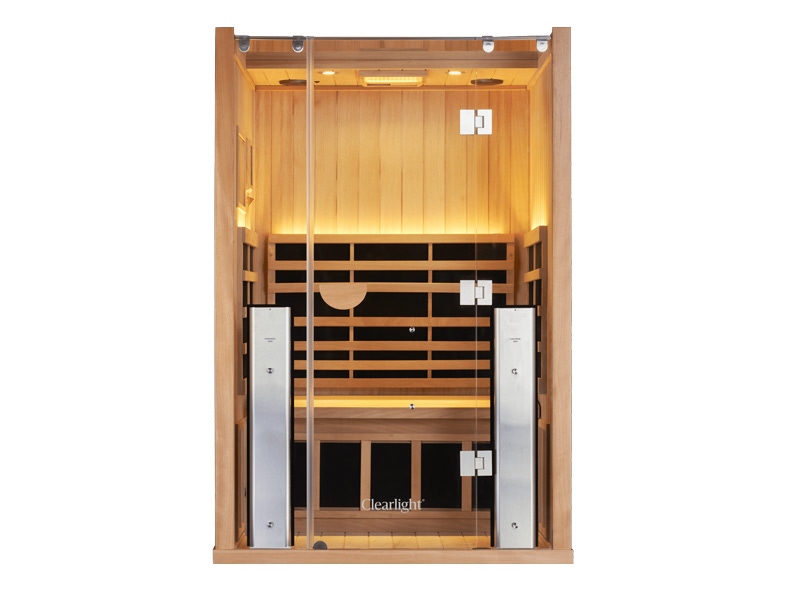
CLEARLIGHT
SANCTUARY 2
| Max temperature | Not published; FAQ states cabin "will typically reach 115-125°F" |
| Heaters | 2 × 500W True Wave™ full-spectrum front wall + True Wave® far infrared on back, sides, calf, floor |
| Circuit required | 120V 20A, NEMA 5-20p (2,260W / 18.83A) |
| Red light included | No — separate tower add-on |
| Published irradiance | Not published |
| Heater emissivity | Not published |
| EMF | Not published numerically |
| Where it's manufactured | Not disclosed — refers to "our factory" and in-house heater development, 4-stage QC |
| Weight | 450 lbs |
| Price | Quote-based |
| Warranty (residential) | Limited lifetime, no year cap stated |
Best High-Heat Infrared Sauna
Sunlighten Amplify RED II
A Full-Spectrum Cabin With Integrated Red Light And The Category's Highest Published Ceiling
Type: Full-spectrum infrared with integrated red and near-infrared | Dimensions: 50.9 x 45.9 x 77.7 inches | Capacity: 2 people | Power requirement: Dedicated 240V/20A circuit (NEMA 6-20) | Max temp: 170 degrees | HSA/FSA eligible: Yes (via Truemed) | Warranty: 7 years (cabinetry and heaters), 3 years (controls), 1 year (glass doors and audio)
Best for:
- Anyone who wants the highest published maximum temperature among premium two-person infrared cabins
- Red and near-infrared light engineered into the cabin walls rather than added as a tower
- Buyers who want performance numbers with a named lab, instrument and test date behind them
Skip if:
- You want per-wavelength dosing and preset wellness programs — that's Sunlighten's mPulse line
- Your electrical panel can't accommodate a dedicated 240V circuit
- You want to compare prices without a consultation call
The Highest Published Ceiling In The Group
Amplify RED II is engineered to reach 170°F. Three full-spectrum heaters at 500W each sit alongside five far-infrared heaters, adding heat intensity on top of the far-infrared foundation, and light and heat run on independent controls so intensity is a per-session choice. It is the only cabin here that publishes a figure above 165°F.
Light Engineered Into The Cabin, Not Added To It
Red and near-infrared light delivers photobiomodulation, a different mechanism from heat. Because intensity falls off with the square of the distance from the source, placement determines dose. Sunlighten integrated the emitters throughout the cabin walls, with wavelength, proximity, dose and session duration informing the layout, rather than mounting a panel or standing a tower in the corner. Heater covers use mineral-infused CELLIANT® fabric as an additional infrared layer.
The Numbers Come With A Lab Attached
Heater emissivity was measured at 0.99 by Bruker Analytical Services on March 1, 2022, using a Vertex 70 FTIR spectrometer at 45° incidence, with testing by Peng Wang, Ph.D. The same test measured standard SoloCarbon® at .95 and a conventional carbon surround at .93. It is the only third-party emissivity measurement published by any brand in this comparison — the one other 99% figure here is self-declared, by that company's own statement.
On EMF, Sunlighten names Vitatech Electromagnetics and publishes the full test report as a downloadable PDF, with heater panels measuring "0.5 mG or less" and some as low as 0.1 mG. That distinction matters more than the number: of the four, one publishes the complete report, one publishes a summary and states the signed report is not public, and two publish neither. Sunlighten is also the only brand here that names the country its saunas are built in.
Where it doesn't lead: Sunlighten publishes no cabin-air VOC or off-gassing results, where Sun Home publishes named-lab testing to a stated EPA method.
Best-Documented Materials Testing
Sun Home Eclipse 2-Person
The Heaviest Cabin Here, With Named-Lab VOC Data Nobody Else Publishes
Type: Full-spectrum infrared with built-in red light towers | Dimensions: 51.5 x 47.2 x 76.7 inches | Capacity: 2 people | Power requirement: Dedicated 30A circuit (NEMA L5-30) | Max temp: 165 degrees | HSA/FSA eligible: Not confirmed on pages reviewed | Warranty: "Limited lifetime" — capped at 7 years in Sun Home's own terms; 3 years (controls), 1 year (LED, glass, audio)
Best for:
- Buyers who want VOC and off-gassing data with a named laboratory and a test method behind it
- A heavy, solidly built cabin — at 600 lbs it's the heaviest here
- The best first-90-days service terms of the four
Skip if:
- Your electrical panel can't support a dedicated 30-amp circuit — the heaviest demand of the four
- You want red light engineered into the walls rather than delivered by towers
- You're relying on the word "lifetime" in the warranty
Materials Testing Nobody Else Here Matches
This is the category Sun Home earns outright, and it's worth being precise about its scope: materials, not safety across the board.
Sun Home publishes cabin-air VOC testing by VERT Environmental and LA Testing, an AIHA-accredited lab, using EPA Method TO-15 — a total VOC result of 27 µg/m³, classified as low, tested April 2, 2026, with benzene, toluene, xylenes, styrene and formaldehyde among the compounds not detected. Its cabin-assembly adhesive was separately tested by Applied Technical Services (report #486424, June 18, 2026): formaldehyde none detected, total VOC content below 0.001% by weight. No other brand in this comparison publishes anything comparable.
Its disclosure practice is also unusually candid. The EMF explainer names its lab, publishes a seated-position range rather than one flattering number, and warns readers that the widely quoted "0.5 mG" figure "should not be presented as a universal seated-position or whole-cabin reading." Its emissivity page publishes 99% and states plainly, in the same breath, that the figure "has not been independently verified by a third-party lab in publicly available documentation."
Where The Documentation Stops
Two limits are worth knowing, because they're the reason this category is scoped to materials rather than safety generally. Sun Home's EMF figure is published as a summary, not the underlying report — the company states that "the complete signed laboratory report and raw spatial dataset are not currently public." And the Eclipse product page itself publishes no numerical EMF at all, only "patented shielding," so a buyer on the PDP never sees the number the company is proudest of. Its emissivity figure remains self-declared by its own admission.
The Heaviest Cabin In The Comparison
The Eclipse pairs six far-infrared heaters with two full-spectrum heaters inside a Canadian hemlock cabin, with red light therapy included as built-in towers at 660 and 850 nm, each with its own remote. At 600 lbs it's the heaviest cabin in this comparison — 38 lbs more than the heaviest Amplify RED II configuration and 150 lbs more than the Sanctuary 2.
Read The Warranty Clauses
Sun Home's "limited lifetime" coverage on cabinetry and heaters is defined in its own terms as "applicable for up to seven (7) years" — the same term Sunlighten publishes without the lifetime framing. The warranty is non-transferable, and it is voided if the sauna is installed within five feet of any water source, explicitly including a cold plunge, which matters if you're planning both in one room. Against that, its first 90 days are the best-covered of the four: parts, labor and shipping at no cost.
Best High Heat Without An Electrician
Heavenly Heat 2-Person Red Light Therapy Infrared Sauna
165°F On Standard Household Outlets, And The Longest Warranty Term Here
Type: Far and near infrared with a five-wavelength red light panel | Dimensions: 47.2 x 41.3 inches (interior; exterior not published) | Capacity: 2 people | Power requirement: 120V — two 15A circuits, or one dedicated 20A | Max temp: 165 degrees (stated in the FAQ; the product page declines to give a figure) | HSA/FSA eligible: Not confirmed on pages reviewed | Warranty: 10 years (cabinet, heaters, electrical), 5 years (red light panel)
Best for:
- Anyone who can't add a dedicated circuit — it runs on two ordinary 120V/15A outlets and still reaches 165°F
- Renters, apartments, and older homes with limited panel capacity
- The longest stated warranty term in this comparison, at 10 years
Skip if:
- You want a complete spec sheet before you call
- You want emissivity, EMF or VOC figures verified by a named outside lab
- You need published exterior dimensions or weight for planning
The Longest Track Record Here, And A Distinctive Build Method
Heavenly Heat has been building saunas since 1988 — the longest track record of the four, ahead of Clearlight (1997), Sunlighten (1999) and Sun Home (2021). Its construction method is unusual and worth understanding: zero-glue assembly, no plywood, no chemical stains, and wooden speaker covers instead of plastic. The company states its saunas are tested for VOCs and describes the result as no detectable VOCs, though it doesn't publish the lab, method, figure or test date behind that.
Low-VOC, non-toxic construction is not unique to Heavenly Heat — every brand in this comparison addresses it, and Sun Home documents it in the most detail (see below). What is distinctive here is the zero-glue method itself: the cabin is built without wood adhesives at all, rather than with adhesives selected to be low-emitting.
165°F Without Calling An Electrician
This is the category Heavenly Heat owns outright. Its FAQ puts the heat claim directly: "Most Infrared saunas only reach 150F, but ours can go all the way up to 165F." That matches the Eclipse and sits five degrees below the Amplify RED II — but it gets there on two ordinary 120V/15A household circuits, or one dedicated 20-amp. Every other cabin here needs electrical work first: the Amplify RED II a dedicated 240V circuit, the Eclipse a dedicated 30-amp, the Sanctuary 2 a dedicated 20-amp. For a renter, an apartment, or an older home with a full panel, that difference can decide the purchase before any spec sheet matters.
It also publishes red light irradiance at three distances, which almost nobody in this category does.
Worth noting for anyone comparing spec sheets: the product page itself no longer states a maximum temperature, explaining instead that "your sauna's ambient temperature and available power draw significantly impact both heat-up time and maximum temperature — factors outside our control." That's a fair caveat, and arguably a more honest one than a flat number. It also means the 165°F figure lives only in the FAQ.
Where The Spec Sheet Stops
Heavenly Heat publishes the least technical detail of the four: no heater count, no total wattage, no per-band wavelengths, no emissivity, no weight, no exterior dimensions, and no methodology behind its "<2mg" EMF figure. The 10-year warranty is genuinely the longest stated term here, but it excludes labor and shipping entirely and is non-transferable.
Best For Longer, Lower-Temperature Sessions
Clearlight Sanctuary 2
A Cooler Cabin By Design, And The Only Uncapped Warranty
Type: Full-spectrum infrared (red light sold separately) | Dimensions: 51.75 x 47.75 x 77 inches | Capacity: 2 people | Power requirement: 120V/20A (NEMA 5-20p) | Max temp: Not published; brand states the cabin "will typically reach 115-125°F" | HSA/FSA eligible: Not confirmed on pages reviewed | Warranty: Limited lifetime, no year cap stated
Best for:
- Longer, more comfortable sessions at lower cabin temperatures
- The only warranty in this comparison with no year cap written into its terms
- An under-floor foot heater no other cabin here includes
Skip if:
- High heat is why you're buying — this cabin is not built for it
- You want red light included rather than sold separately
- You want to compare prices without a consultation call
Cooler On Purpose, And Upfront About It
Clearlight belongs in this comparison because buyers shop it against the others, but it isn't competing for the high-heat buyer and doesn't claim to be. Its own FAQ states that its saunas "work effectively at comfortable temperatures of 115-125°F," and that even with the thermostat set higher, "the cabin will typically reach 115-125°F — this is by design, as infrared saunas heat your body directly rather than the air." That's a coherent engineering position, stated plainly rather than buried.
The Warranty That Survives The Fine Print
Three saunas in this group are marketed with lifetime language. Clearlight's is the only one with no year cap written anywhere in its terms, covering heaters, controls, electrical, wood and audio. If warranty is the factor that decides your purchase, this is the one to read closely.
What Isn't Published
No maximum temperature, no emissivity figure, and no numerical EMF reading with a named lab, date or instrument. Red light therapy isn't included — it's a separate tower add-on, making this the only cabin of the four where red light is a paid extra. Pricing is quote-only, with financing "as low as $146 per month" shown but no total. At 450 lbs it's the lightest cabin here.
How we compared
Every figure comes from the manufacturer's own published pages, accessed September 23, 2026, with independent test data cited to the laboratory that produced it. We compared like-for-like: all four are two-person indoor cabins. We did not test these saunas head-to-head, and we say plainly where a number is a manufacturer claim rather than a measured result.
One finding applies to every sauna here, ours included: no maximum-temperature claim in home infrared has been verified by an independent laboratory protocol. Sun Home's own article on the subject reaches the same conclusion — "no source we reviewed used an independent instrument or laboratory protocol to verify a 170°F cabin-air temperature." Treat every temperature in the table above as a manufacturer figure. Heavenly Heat's product page goes a step further and declines to state a maximum at all, on the grounds that ambient conditions and available power are outside the manufacturer's control. That caveat is true of every sauna in this comparison.
What to look for in a high-heat sauna
Heater surface temperature matters more than air temperature. By Wien's displacement law, the peak wavelength a surface emits is inversely proportional to its absolute temperature — so as a heater's surface gets hotter, the wavelength it emits gets shorter, moving away from the roughly 9.4-micron band the human body absorbs most efficiently. A heater governed only by cabin air temperature cycles on and off, so the delivered wavelength drifts through the session.
Cabin temperature is not set by input power. The Eclipse draws 2,820W and reaches 165°F. The Sanctuary 2 draws 2,260W — about 25% less — and targets 115–125°F. A quarter more power, forty-plus degrees apart in outcome. What separates them is insulation, glazing, heater placement and what the control system targets. Wattage tells you what circuit you'll need, not how hot the room gets.
Ask for irradiance at the seated distance, not at six inches. Light intensity falls off with the square of the distance from the source, so a headline number measured at the panel face says little about what reaches a body on the bench.
Ask what "lifetime" means in writing. Ask whether it's defined in the terms and at how many years, who pays labor and freight and starting when, whether it transfers if you sell, and what voids it.
Ask who manufactures it, and where. A company that runs its own production controls the heater coating, the substrate, the surface-temperature calibration and the final quality control. A company that buys finished cabins controls the badge. Of these four, only one publishes the answer.
Frequently asked questions
What is the hottest infrared sauna?
Is a hotter infrared sauna better?
Does a sauna with more watts get hotter?
Which of these is best for someone sensitive to off-gassing?
Which brand is most transparent about safety testing overall?
What electrical circuit does a high-heat sauna need?
Is red light better integrated into the sauna or delivered by a tower?
Which of these has the best warranty?